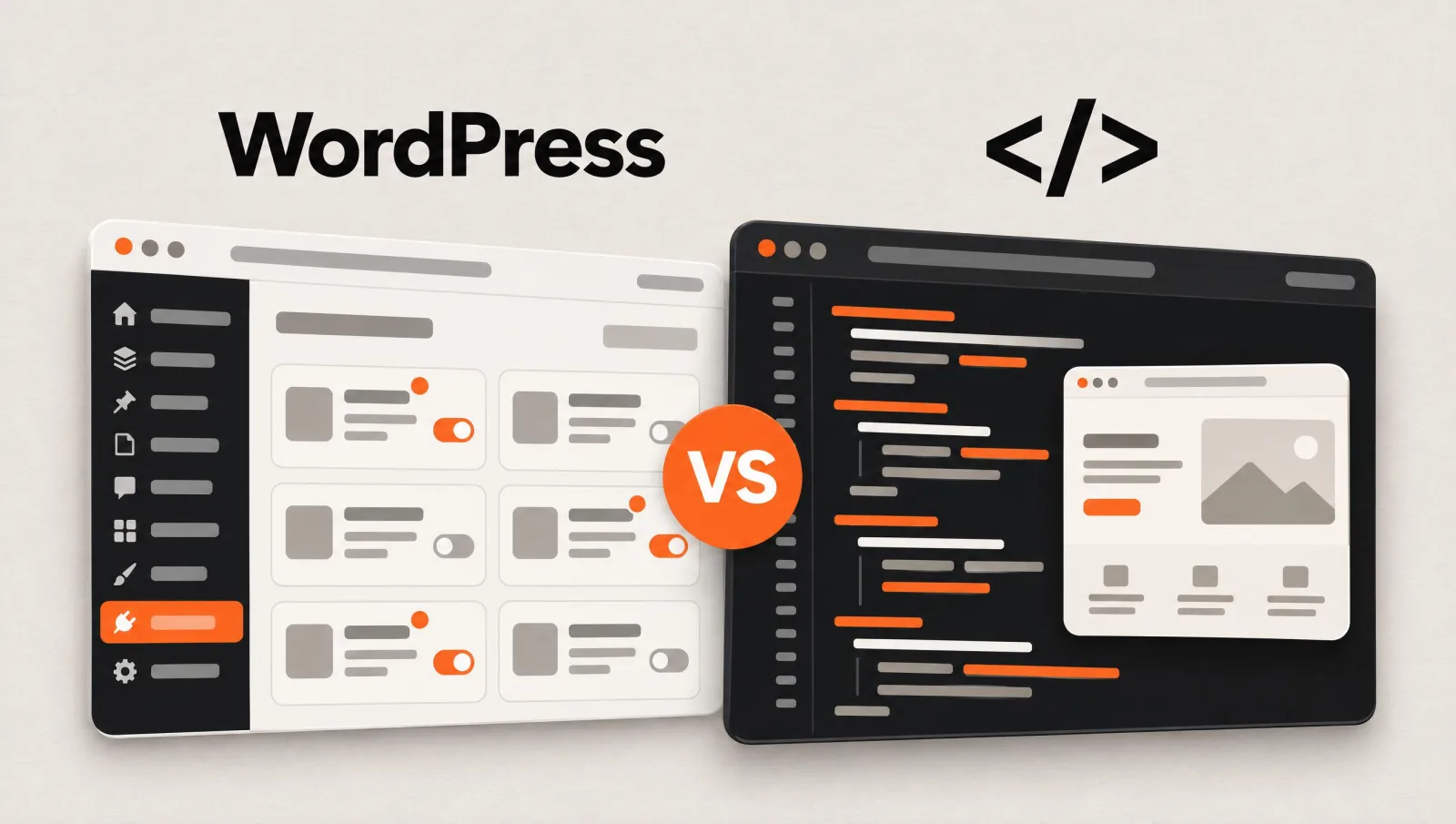
When someone says “I need a website”, they usually mean one of two things: a marketing presence (introduction, services, contact, blog, sometimes sales) or a product (portal, platform, user roles, integrations, automation). WordPress and custom development are often compared as if they were the same category – they aren’t. WordPress is the fastest route to content and marketing. Custom development is the cleanest route to a system that does exactly what you need. Both can be excellent or poor, depending on how they’re used.
Two myths
- “Custom is always better.” It isn’t. For a simple marketing site it’s often overkill.
- “WordPress is always cheaper.” Not that either. It can get expensive once it turns into a patchwork of plugins and fixes.
The real question is: what should the site do, how soon do you need it, and who will maintain it?
1. Time to results: WordPress wins
WordPress is a great choice for a site that presents services, collects inquiries, runs a blog, shows references and hosts campaign landing pages. There are ready-made builders and plugins, a professional look comes quickly and content is easy to add. A custom build for the same needs means a longer timeline and more steps, for little gain.
Rule: if the goal is marketing and content, WordPress is almost always the more rational choice.
2. Cost: the whole lifecycle, not just the build
The build is only part of the cost. Maintenance, risk and future changes make up the rest.
Hidden costs of WordPress
- annual licenses for plugins and the builder,
- updates that can cause conflicts,
- security risks that come with the platform’s popularity,
- slower performance as plugins and effects pile up.
Hidden costs of custom development
- a higher initial investment, because there are no ready-made parts,
- dependence on the team that built it – especially without documentation,
- every new feature is developed, not “installed”.
Rule: WordPress is usually cheaper to start, while custom is more stable once the system becomes serious and specific.
3. Maintenance: WordPress needs discipline, custom needs ownership
WordPress is like a city built from LEGO bricks: quick to build and easy to extend, but the more pieces you add, the higher the chance something breaks. A custom solution is like a house built from the foundation up: slower, but you know exactly what is where and you depend less on other people’s parts.
WordPress without regular maintenance becomes a risk. A custom system without clear ownership – who maintains it, who deploys changes, who monitors errors – becomes a risk too. Without a maintenance plan, both options are bad, just in different ways.
4. SEO and content: WordPress still leads
If a blog, content and SEO drive your strategy, WordPress is the natural choice: content is easy to edit, the SEO ecosystem is huge, and categories, tags and internal links work out of the box. A custom site can be excellent for SEO, but everything has to be done right – URLs, meta data, schema markup, performance, sitemap and canonical URLs. With WordPress, most of that comes ready.
5. Growth and complex features: custom wins
WordPress can handle serious websites, but there’s a point where roles and permissions get complicated, integrations multiply, the workflow is specific and performance must be top-notch. That’s when custom – or a hybrid – is the smarter choice: you get exactly what you need, without excess, and it’s easier to optimize logic all the way.
Rule: if you’re building a product – SaaS, portal, platform – custom usually pays off long-term. See also our custom CRM systems.
6. Security: popularity vs control
WordPress is the world’s most popular CMS, so it’s also the most frequent target of attacks. That doesn’t make it insecure; it means it requires discipline: regular updates, trusted plugins, backups, strong authentication and a minimum of plugins. A custom system is a rarer target, but it can be insecure if built poorly. Security depends on process, not on the platform.
The shortest guide: what to choose
WordPress, if:
- you need a marketing site and a blog,
- you want to launch fast,
- your needs are standard – forms, galleries, landing pages,
- you want to edit content yourself, without a developer.
Custom, if:
- you’re building a platform or product with specific rules,
- you have complex roles, workflows and integrations,
- speed and stability are critical,
- the system will grow and change often.
Hybrid – often overlooked, often the best
WordPress for content and marketing, a custom part for the app or portal (or WordPress as a headless content source). You get the best of both worlds.
Conclusion: don’t choose technology, choose risk
WordPress brings speed and an ecosystem; custom brings control and precision. The best decision is the one that reduces risk for your specific case – budget, deadline, team and goals.
We build both, so we can recommend what makes sense for your business. Read more on our website development page.